

Unified data for industrial operations.
Built by people and AI agents together, OT Fabric creates open-source protocol libraries and tools that break down operational technology (OT) data silos, so industrial data is easy to discover, access and use across systems, sites and teams.
Open building blocks for industrial connectivity
Protocol libraries
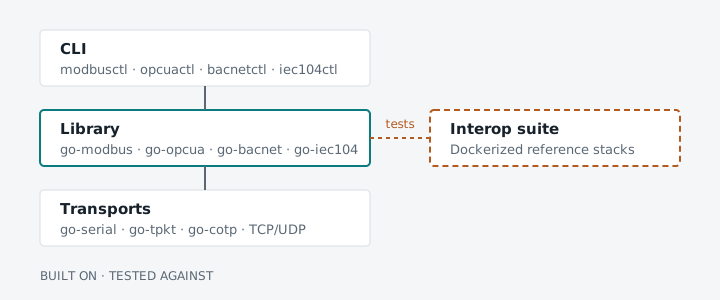
Pure Go clients and servers for Modbus, OPC UA, BACnet/IP, IEC 60870-5-104, IEC 61850, Siemens S7, SunSpec and OpenADR. No cgo.
CLICommand-line tools
One tool per protocol to discover, read, write and diagnose devices in the field, with JSON output for scripts and CI.
DiscoveryProtocol fingerprinting
go-otfp detects which OT protocols are running on a network from transport framing alone.
UIUI apps
SunSpec Explorer shows every model of an inverter, meter or battery fully decoded, on the desktop or in a browser.
InteropInteroperability testing
Every protocol is tested against independent stacks in public, Dockerized suites.
What you can connect today
Every library, CLI and interop suite is MIT-licensed and public on GitHub.
Industrial data should not stay trapped
There is enormous potential in connecting the devices that run our factories, grids and buildings. Energy shows it most clearly: a sustainable, decentralized grid only works when solar inverters, batteries, meters and substations exchange data reliably.
Yet that data is locked inside PLCs, RTUs, meters, inverters and building controllers. Every device speaks its own protocol, documentation is often incomplete, and integrations are rebuilt from scratch for every site and vendor. We think the foundation for industrial connectivity should be open, well tested and reusable, so that nobody has to solve the same protocol problem twice.
Built with AI agents
OT Fabric is built by people and AI agents working together. We are heading toward a reality where LLMs write better code and deliver more secure software, and we build for that reality today. Engineers bring the domain knowledge of real OT systems, set direction and own every decision. Agents bring speed, breadth and attention to detail.
Speed alone is not the goal. Industrial protocols leave no room for "mostly works", so everything we ship is held to the same bar: public code, public tests and interoperability suites that check it against other implementations.
Made for people who connect real equipment
Energy and electricity startups
Building the software that connects solar, storage, EV charging, grid and DER equipment. Open, tested stacks let a small team integrate real hardware fast.
OT and automation engineers
Commission, troubleshoot and maintain field devices with one CLI per protocol.
System integrators
Connect equipment from many vendors across many sites with the same toolkit.
Data and software teams
Get reliable, typed access to industrial devices from modern Go code.
Roadmap
Every relevant OT protocol
Full coverage, so any industrial device can be reached with the same open, tested toolkit.
IT2OT gateways and connectors
Move OT data safely into the IT, cloud and analytics systems that need it.
OT MCP servers
A structured, safe way for AI agents to discover, read and work with industrial devices.
Latest posts
Bring your own agent
Try a CLI, open an issue, or contribute a fix, written by you, your AI agent or both of you. Everything is MIT-licensed unless a repository says otherwise.