

Notes from the fabric
Release notes, protocol deep dives and how OT Fabric is built, by people and AI agents together.
 · 7 min read
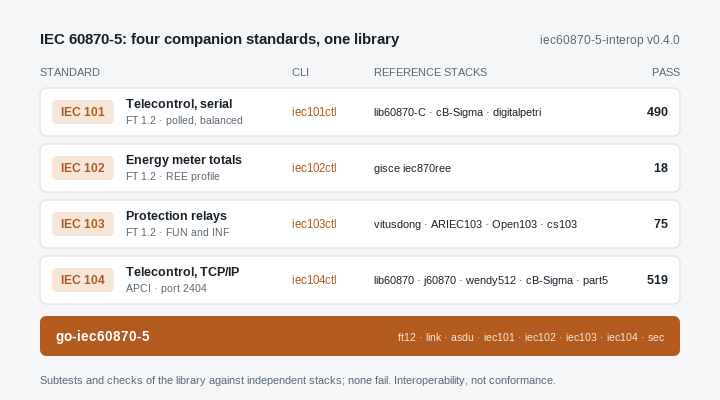
IEC 60870-5 in full: one library for IEC 101, 102, 103 and 104
go-iec60870-5 implements the four companion standards of IEC 60870-5 under MIT, from serial telecontrol to meter totals, protection relays and IEC 104. iec60870ctl ships iec101ctl to iec104ctl, and iec60870-5-interop tests it all against independent stacks.
- #announcement
- #iec-101
- #iec-102
- #iec-103
- #iec-104
- #scada
- #energy
- #interop
 · 9 min read
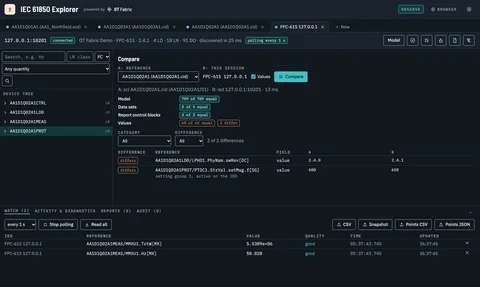
IEC 61850 Explorer: one workbench for IEDs, SCL files and station bus captures
Inspect an IED without the risk of changing it, review an SCD before the hardware exists, prove a device runs the configuration on file, operate controls with an audit trail and find out what went wrong from a capture of the station bus. Vendor-neutral, open source and read-only by default.
- #announcement
- #tools
- #iec-61850
- #commissioning
- #troubleshooting
 · 5 min read
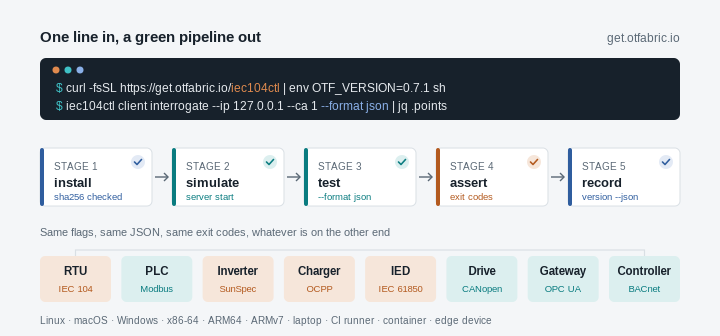
One line to install every OT Fabric tool, for people and for pipelines
Every OT Fabric command-line tool, from modbusctl and iec104ctl to otprobe and mbcapctl, now installs with one line from get.otfabric.io. And because every tool now shares JSON output, exit codes and version reporting, the same tools run in CI/CD pipelines, scripts and Docker images.
- #announcement
- #tools
- #automation
- #testing
 · 9 min read
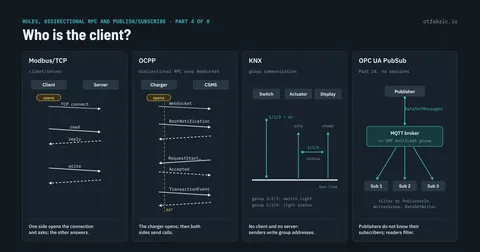
Who is the client? Industrial roles, bidirectional RPC and publish/subscribe
Does the participant that opens the connection always control the conversation? Not in OCPP, where chargers dial out and then answer remote commands; not in KNX, where there is no client at all; and not in OPC UA, where reverse connect and PubSub change the picture. Connection ownership, application roles and message direction are separate design concerns.
- #software-architecture
- #protocols
- #networking
 · 11 min read
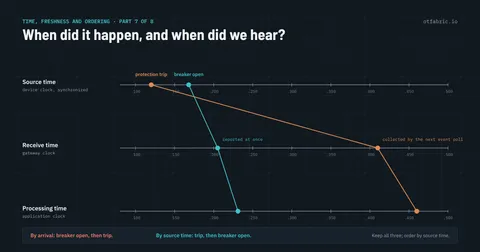
Time, freshness and ordering in industrial communication
When an industrial measurement arrives, what do you actually know about its age? Source time, acquisition time and receive time differ; sampling and publishing intervals differ; arrival order is not occurrence order; and a value can look perfectly plausible long after it went stale. How Modbus, OPC UA, DNP3, IEC 104, IEC 61850, EtherNet/IP, PROFINET and CANopen help, and where they do not.
- #software-architecture
- #protocols
- #scada
- #data
 · 12 min read
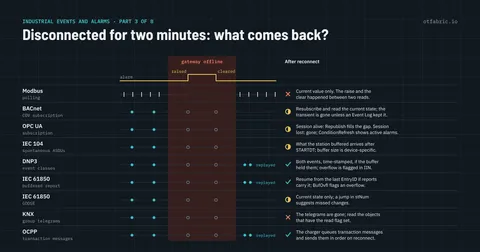
Industrial events and alarms: delivery, persistence and recovery
When something changes while you are disconnected, can you find out afterwards? BACnet, OPC UA, IEC 104, DNP3, IEC 61850, CANopen, KNX and OCPP answer differently, from recovered history with time stamps to a known gap to silent loss. Support for notifications is not the same as guaranteed event history.
- #software-architecture
- #protocols
- #scada
- #alarms
 · 13 min read
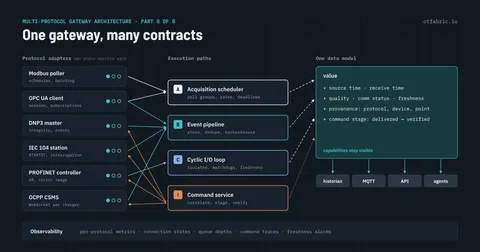
Designing a multi-protocol OT gateway without hiding the differences
How should a software engineer design an application that talks to Modbus, OPC UA, DNP3, IEC 104, PROFINET and OCPP at once? Not with one universal device client. Capability-driven adapters, separate polling, event, cyclic and command paths, explicit lifecycle state machines, and values that carry time, quality and provenance keep the protocol contracts intact.
- #software-architecture
- #protocols
- #interop
- #engineering
 · 11 min read
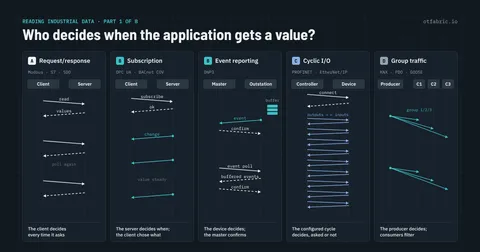
Reading industrial data: polling, subscriptions, events and cyclic I/O
Who decides when your application receives a measurement? In Modbus and S7 the client does; in OPC UA and BACnet a subscription hands that decision to the server; in DNP3 and IEC 104 the device reports and keeps events; in PROFINET, EtherNet/IP and CANopen a configured cycle does. Each choice has a cost in freshness, device load and correctness.
- #software-architecture
- #protocols
- #scada
- #automation
 · 11 min read
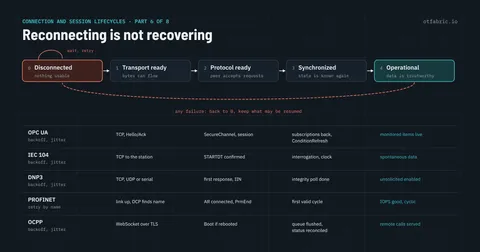
Reconnecting is not recovering: industrial connection and session lifecycles
What state must be rebuilt after an industrial connection fails? A new socket is only the first of several steps. OPC UA, IEC 104, DNP3, PROFINET, EtherNet/IP, CANopen, OCPP, OpenADR and IEEE 2030.5 each need their own sequence of session setup, resynchronization and replay before data can be trusted again.
- #software-architecture
- #protocols
- #networking
- #scada
 · 11 min read
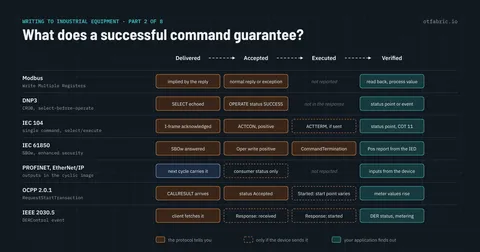
Writing to industrial equipment: why an acknowledgement is not the same as execution
What does a successful command actually guarantee? A Modbus write, a DNP3 select-before-operate, an IEC 104 command, an IEC 61850 control, a PROFINET output, an OCPP remote start and an IEEE 2030.5 DER control each confirm something different. Separating delivered, accepted, executed and verified makes retries safe and results honest.
- #software-architecture
- #protocols
- #scada
- #energy
 · 16 min read
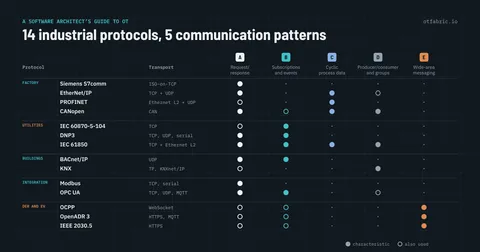
14 industrial protocols, 5 communication patterns: a software architect’s guide to OT
Industrial communication is not one architecture with fourteen wire formats. Modbus, OPC UA, BACnet, IEC 104, IEC 61850, S7, DNP3, EtherNet/IP, PROFINET, CANopen, KNX, OCPP, OpenADR and IEEE 2030.5 make different promises about who speaks, when data moves, what an acknowledgement means and what survives a failure. This guide maps them onto five patterns, and those patterns onto software architecture.
- #software-architecture
- #protocols
- #interop
- #engineering
 · 11 min read
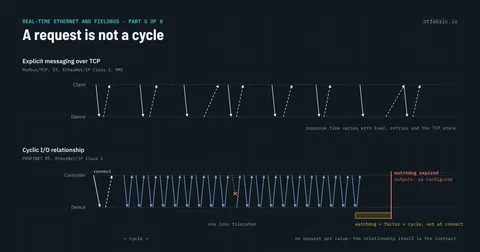
Why industrial real-time communication is not just faster TCP
PROFINET, EtherNet/IP, CANopen, IEC 61850 GOOSE and Sampled Values bypass ordinary request/response networking for a reason. Real time is about bounded latency, jitter, deadlines, watchdogs and freshness, not raw speed, and it changes what your software, your containers and your test networks must provide.
- #software-architecture
- #protocols
- #networking
- #automation
 · 7 min read
CANopen on CAN bus: go-canopen, canopenctl and three independent reference stacks
CANopen is the protocol that turns a CAN bus into a network of drives, I/O modules and machines. go-canopen implements it under MIT on top of go-canbus, with LSS, the CiA 302 network boot-up, EDS files, CiA 402 drives and CANopen FD, canopenctl puts it on the command line read-only by default, and canopen-interop tests it against CANopenNode, Lely CANopen and python canopen.
- #announcement
- #canopen
- #can-bus
- #interop
 · 6 min read
KNX joins OT Fabric: go-knx, knxctl and four independent reference stacks
KNX is the building control standard of switches, dimmers, blinds and heating valves. go-knx implements KNX over KNXnet/IP under MIT, with tunnelling, routing, a KNXnet/IP server, KNX IP Secure and Data Secure, knxctl puts it on the command line passive by default, and knx-interop tests it against Calimero, knxd, xknx and KNXUltimate.
- #announcement
- #knx
- #buildings
- #interop
 · 6 min read
CAN bus joins OT Fabric: go-canbus, canbusctl and independent reference stacks
CAN connects the controllers inside battery packs, inverters, chargers, vehicles and machines. go-canbus implements classical CAN, CAN FD and CAN XL under MIT, with ISO-TP, seven trace formats and DBC, KCD and ARXML databases, canbusctl puts it on the command line with safety guards for real buses, and canbus-interop tests it against seven independent implementations.
- #announcement
- #can-bus
- #energy
- #interop
 · 3 min read
openadrctl: OpenADR 3 from the command line, in every role
openadrctl acts as a VEN or as Business Logic against any OpenADR 3 VTN, publishes prices and limits, listens for notifications by webhook, MQTT or WebSocket, and serves a test VTN from a seed file. With go-openadr v0.5.0 it also talks to VTNs of OpenADR 3.0.1.
- #announcement
- #openadr
- #tools
- #energy
- #interop
 · 6 min read
PROFINET joins OT Fabric: go-profinet, profinetctl and independent reference stacks
PROFINET IO connects PLCs to the remote I/O, drives and field devices of a plant. go-profinet implements IO-Controller and IO-Device under MIT, with DCP, records, alarms, GSDML and MRP rings, profinetctl puts them on the command line, and profinet-interop tests both on real Layer 2 networks against independent implementations.
- #announcement
- #profinet
- #automation
- #interop
 · 7 min read
Full IEC 61850 in OT Fabric: MMS, GOOSE and Sampled Values in one library
OT Fabric's IEC 61850 stack now covers the whole communication side of the standard. go-iec61850 adds GOOSE and Sampled Values to a hardened MMS client and server, iec61850ctl sniffs, subscribes and publishes on the station bus, and iec61850-interop tests both against four independent stacks.
- #announcement
- #iec-61850
- #substation
- #energy
- #interop
 · 7 min read
otprobe: which OT protocol is on that port, and which device is behind it
go-otfp v0.1.0 is a rewrite of OT Fabric's protocol fingerprinting library. It detects 14 OT protocols over TCP, UDP and TLS with safe, read-only probes, reads the device identity each protocol offers, and ships with otprobe, a command-line tool for the field.
- #announcement
- #tools
- #networking
- #discovery
 · 6 min read
Sparkplug B joins OT Fabric: go-sparkplugb, sparkplugbctl and six reference stacks
Sparkplug B gives MQTT the session state that industrial data needs. go-sparkplugb implements edge node, primary host application and application under MIT, sparkplugbctl puts them on the command line, and sparkplugb-interop tests both against six independent implementations on four MQTT brokers.
- #announcement
- #sparkplug-b
- #automation
- #interop
 · 6 min read
EtherNet/IP joins OT Fabric: go-ethernetip, ethernetipctl and twelve reference stacks
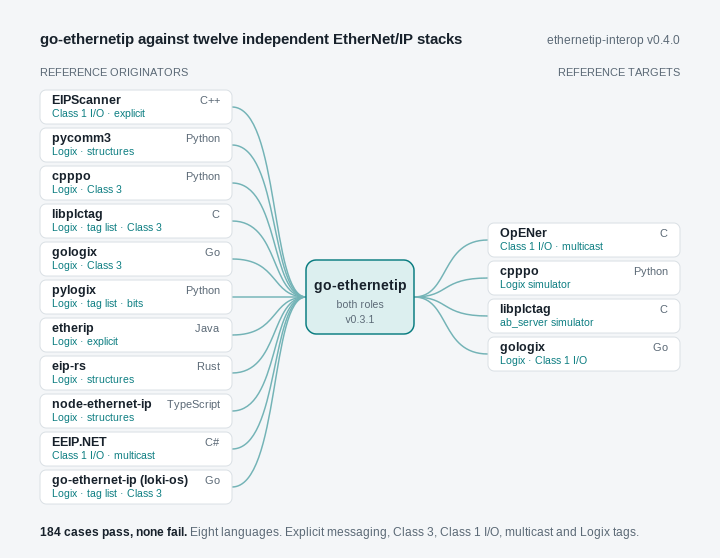
EtherNet/IP is how PLCs talk to the I/O, drives and controllers on the factory floor. go-ethernetip implements client, scanner and adapter under MIT, with Logix tags and EDS files, ethernetipctl puts them on the command line, and ethernetip-interop tests both against twelve independent implementations in eight languages.
- #announcement
- #ethernet-ip
- #automation
- #interop
 · 6 min read
IEEE 2030.5 joins OT Fabric: go-ieee20305, ieee20305ctl and four reference stacks
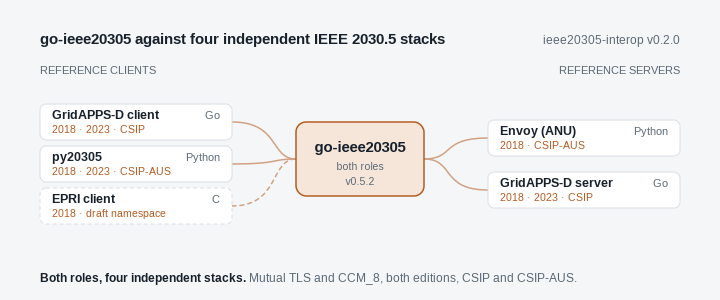
IEEE 2030.5 is how utilities and aggregators tell inverters, batteries and chargers what to do, and the protocol California and Australia require for it. go-ieee20305 implements client, device agent and server under MIT, ieee20305ctl puts them on the command line, and ieee20305-interop tests both against four independent implementations.
- #announcement
- #ieee-2030-5
- #der
- #energy
- #interop
 · 5 min read
DNP3 joins OT Fabric: go-dnp3, dnp3ctl and three reference stacks
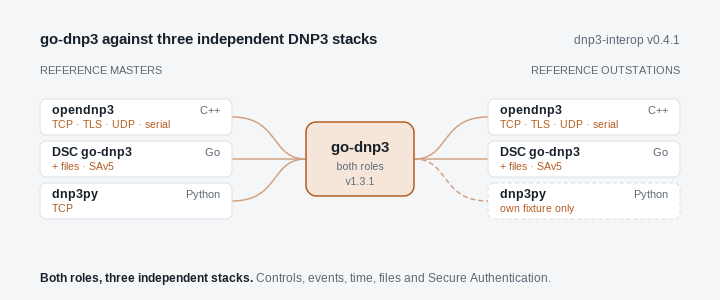
DNP3 is the SCADA protocol of electric, water and oil and gas utilities, and the open-source field around it has thinned out. go-dnp3 implements master and outstation under MIT, dnp3ctl puts it on the command line, and dnp3-interop tests both against three independent implementations.
- #announcement
- #dnp3
- #scada
- #energy
- #interop
 · 5 min read
OCPP joins OT Fabric: go-ocpp, ocppctl and five reference stacks
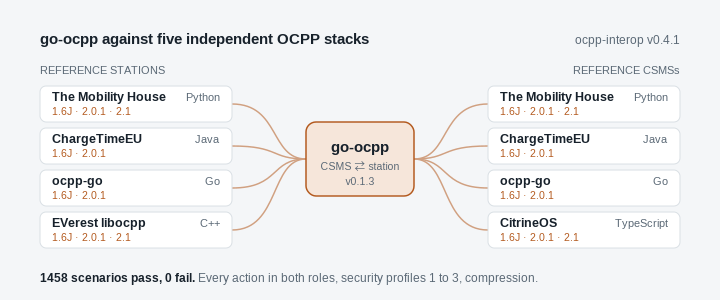
OCPP is the protocol between EV charging stations and the systems that run them. go-ocpp implements 1.6J, 2.0.1 and 2.1 in both roles, ocppctl puts it on the command line, and ocpp-interop tests both against five independent implementations.
- #announcement
- #ocpp
- #ev-charging
- #energy
- #interop
 · 19 min read
The industrial protocol stack landscape
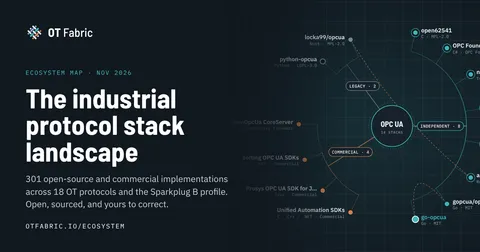
Who implements Modbus, OPC UA, BACnet, IEC 101, 102, 103 and 104, IEC 61850, Siemens S7, OpenADR, OCPP, DNP3, IEEE 2030.5, EtherNet/IP, PROFINET, CAN bus, CANopen, KNX and the Sparkplug B profile? 301 open-source and commercial stacks, verified against their own release channels, and an interactive map to explore them.
- #ecosystem
- #research
- #open-source
 · 5 min read
LAN Tracker: a memory for your OT network
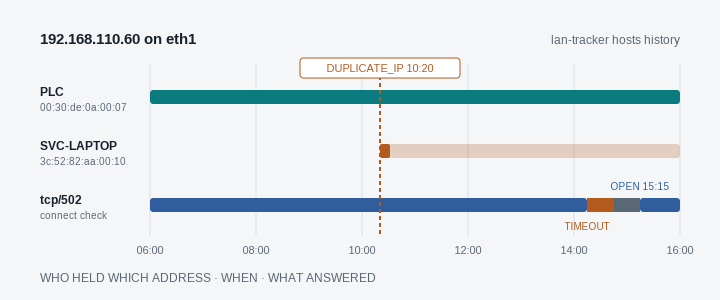
Network problems are one of the top causes of OT downtime, and most leave no trace. LAN Tracker keeps an evidence-based history of which device held which IP, what DHCP told it and which ports answered, so you can reconstruct an incident after the fact.
- #announcement
- #tools
- #networking
- #operations
 · 5 min read
Modbus Trace Explorer: packet traces in Modbus terms
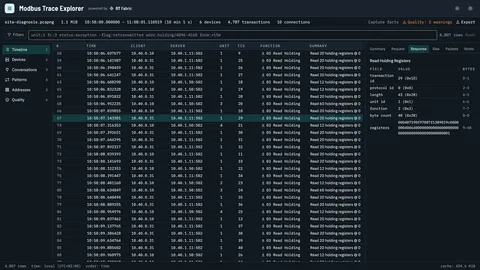
Open a tcpdump or Wireshark capture of Modbus/TCP traffic and see latency per device, poll plans, exceptions, registers and connections. Then export what the devices really answered and replay it as a simulated device.
- #announcement
- #tools
- #modbus
- #troubleshooting
 · 5 min read
Introducing OT Fabric
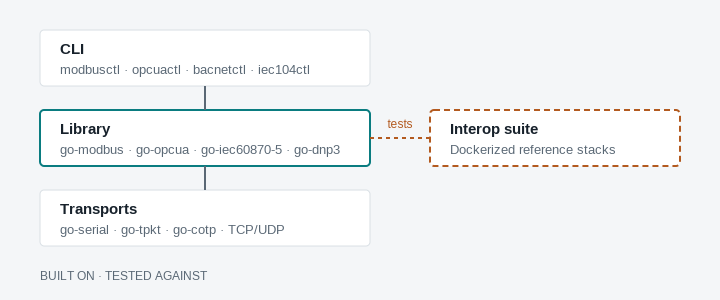
OT Fabric brings open-source DNA and IT best practices to industrial connectivity, for people and AI agents alike. The OT toolset you always wished you had in your pocket, built by people and AI agents together.
- #announcement
- #roadmap
 · 10 min read
Why every protocol gets an interop suite
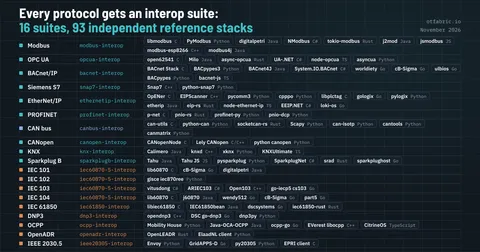
Every OT Fabric protocol is tested against independent implementations. Sixteen interop suites package 93 reference stacks as containers behind one contract, test them against each other first, and record what they find in our code and in theirs.
- #testing
- #interop