

EtherNet/IP joins OT Fabric: go-ethernetip, ethernetipctl and twelve reference stacks
EtherNet/IP is how PLCs talk to the I/O, drives and controllers on the factory floor. go-ethernetip implements client, scanner and adapter under MIT, with Logix tags and EDS files, ethernetipctl puts them on the command line, and ethernetip-interop tests both against twelve independent implementations in eight languages.
Walk along a packaging line or a bottling plant and much of what you see, from the controller in the cabinet to the I/O blocks, drives, valve islands and barcode readers, is likely to be talking EtherNet/IP. It is the industrial Ethernet protocol of the Common Industrial Protocol (CIP): a PLC opens connections to its devices and exchanges their inputs and outputs every few milliseconds over UDP, and any tool can ask a device who it is, read its diagnostics or change its settings with request and response messages over TCP.
Today EtherNet/IP becomes the twelfth protocol in OT Fabric, with the same three pieces as every other: a library, a command-line tool and an interoperability suite.
Why EtherNet/IP, and why now
OT Fabric started with the protocols of energy and infrastructure, and kept running into the factory floor:
- The controllers are already there. Battery systems, water treatment, building plant and manufacturing lines are often run by the same Rockwell Automation, Omron or Schneider Electric controllers, and EtherNet/IP is how you reach them. Getting their data into an energy management system or a historian usually means reading controller tags without a programming tool.
- The open field is mostly tag clients. Our research for the ecosystem map found mature, well-loved libraries in Python, C, .NET and JavaScript, but most read and write Logix tags only. Open stacks that also do cyclic I/O are few, and OpENer, released by Rockwell Automation in 2009, is still the only widely used open adapter.
- Gateways need both roles. An IT-to-OT gateway that collects data, or a test bench that stands in for a missing device, needs to be a scanner on one side and an adapter on the other. That is the kind of building block OT Fabric is for, next to Modbus, OPC UA and Siemens S7 on the same plant network.
go-ethernetip adds an MIT-licensed library with client, scanner and adapter, Logix tags and EDS files in one place, tested against the established stacks.
go-ethernetip
go-ethernetip implements EtherNet/IP and CIP in both roles, with no dependencies outside the standard library.
- A client for explicit messages: sessions, unconnected requests, Multiple Service Packet, routing through a controller’s backplane, Class 3 connections, and discovery with one ListIdentity datagram.
- A scanner for cyclic I/O: Class 1 and Class 0 connections to a device’s assemblies, exclusive owner, input only and listen only, point-to-point and multicast, configuration data, run and idle, timeout detection and automatic reopening.
- An adapter with the standard objects and objects of your own, the ownership rules of the Connection Manager with every refusal’s extended status, shared multicast production and resource limits.
- Rockwell Logix tags, kept apart as the vendor extension they are: reads and writes by name, fragmented transfers, bit writes, the tag list, templates and structures, and an emulated controller that pycomm3, pylogix, libplctag, eip-rs and node-ethernet-ip accept, for tests and simulators.
- Electronic Data Sheets: a parser, validation, a writer and a builder, and a generator that turns a vendor’s EDS into Go constants, assembly structs and scanner configurations.
- Built to run in production:
context.Contexton every call, typed errors with the peer’s CIP status, structured logging, metrics hooks, bounded allocations on every decoder, and EtherNet/IP over TLS for explicit messaging.
It is built from public documents and the behaviour of independent implementations, without ODVA’s specifications, and lists every code it uses with its public source. Behaviour that only the specification defines and no reference exercises is not guessed: it is listed as not implemented.
ethernetipctl
ethernetipctl puts go-ethernetip on the command line, for commissioning, troubleshooting and test setups without hardware.
# No device at hand? A simulated adapter with Logix tagsethernetipctl adapter --listen 127.0.0.1 --echo --logix
# Which devices answer on this segment, and who is this one?ethernetipctl discover --address 255.255.255.255ethernetipctl identify 192.168.1.10
# Check a device step by step: TCP, session, identity, TCP/IP, link, connectionsethernetipctl diagnose 192.168.1.10
# Watch the inputs of an I/O connection without writing outputsethernetipctl io 192.168.1.10 --config 151 --output 152 --input 100 --input-size 32 --rpi 20ms
# A controller tag behind the backplaneethernetipctl tag read 192.168.1.10 Program:Main.Counts[2] --count 5 --route 1/0
It also reads and writes any attribute, lists a device’s objects, tests a Forward_Open and closes a connection by its triad, validates EDS files for CI and generates them from a live device. Every command that changes a device needs --yes, and it never scans address ranges. Output is text, a table or JSON with stable exit codes. The ethernetipctl guide walks through it.
Tested against twelve independent stacks
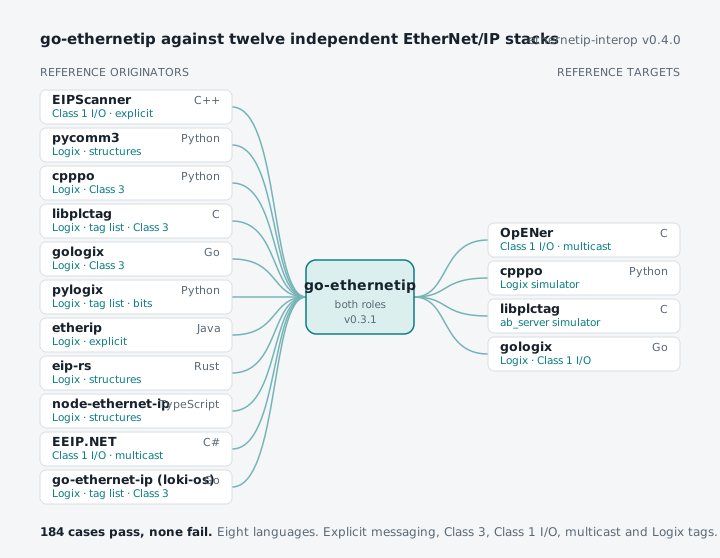
ethernetip-interop packages twelve independent EtherNet/IP implementations, in eight languages, as containers behind one contract. Four are targets: OpENer (C, the only open adapter with multicast and listen-only), cpppo (Python, a Logix-style simulator), libplctag’s ab_server (C) and gologix (Go, a Logix tag server with Class 1 I/O). Eleven are originators: EIPScanner (C++) and EEIP.NET (C#) as scanners with Class 1 I/O, and pycomm3, pylogix, cpppo, libplctag, gologix, etherip (Java, from the EPICS world), eip-rs (Rust), node-ethernet-ip (TypeScript) and loki-os’s go-ethernet-ip (Go) for generic CIP and Logix tags. Every originator is first tested against every target.
go-ethernetip runs in both directions on every push. Its originator runs against OpENer, cpppo, ab_server and gologix: identity, attributes, errors, Class 3, Large_Forward_Open, Class 1 I/O with configuration data, multicast with a listen-only connection next to its owner, and Logix reads and writes. The eleven reference originators run against its adapter and its emulated controller: Class 1 I/O from EIPScanner and EEIP.NET, refusals, Multiple Service Packet, routing, and the Logix drivers of pycomm3, pylogix, libplctag, eip-rs and node-ethernet-ip opening a session, listing the tags and reading and writing tags and bits, with structures and STRINGs from pycomm3, eip-rs and node-ethernet-ip. 184 cases pass, none fail, and 146 are not applicable because a reference has the role but not the feature. The coverage matrix shows what each reference covers.
The references taught us things too. OpENer drops a first request with sequence 0 as a repeat, EIPScanner sends I/O from an ephemeral port, pycomm3 sends each Write Tag twice in one message, cpppo closes the session on an unknown tag, and gologix’s server panics on a Forward_Open with 16-bit segments. They also found three bugs of our own, fixed in go-ethernetip v0.3.0 (v0.3.1 adds the twelfth reference with no change to the library): pylogix, node-ethernet-ip and libplctag read the last member name of a structure template two octets short, a large Logix read did not fit a small Class 3 connection, and node-ethernet-ip packs about 220 requests into one Multiple Service Packet where we allowed 200. Each is recorded with how it is handled.
Built with AI agents
Like the rest of OT Fabric, the EtherNet/IP projects are built by people and AI agents together. Every CIP code the library knows comes from a catalog that names its public source, the comparison with other stacks was checked against their own code and documentation, and the documentation of ethernetipctl is regenerated from real runs against the simulated adapter. The tests, the interop matrix and the list of limitations are public, so you can judge the result yourself.
Who else implements EtherNet/IP
The ecosystem map now covers EtherNet/IP: 22 implementations, from OpENer, libplctag and pylogix to Rust, Go, Java and Node.js libraries, the EPICS driver used at particle accelerators, and commercial stacks and firmware from RTA, Hilscher, Pyramid Solutions, CODESYS and Beckhoff, with language, licence, roles and latest release.
157 implementations · 11 protocolsExplore EtherNet/IP on the ecosystem mapFilter by language, licence and activity, then jump straight to the source.Who maintains the standard, what it costs to license and certify a product, and where to test it against other vendors’ devices is in ODVA’s entry in the standards and alliances directory.
Start with the EtherNet/IP overview, or go get github.com/otfabric/go-ethernetip.