

14 industrial protocols, 5 communication patterns: a software architect’s guide to OT
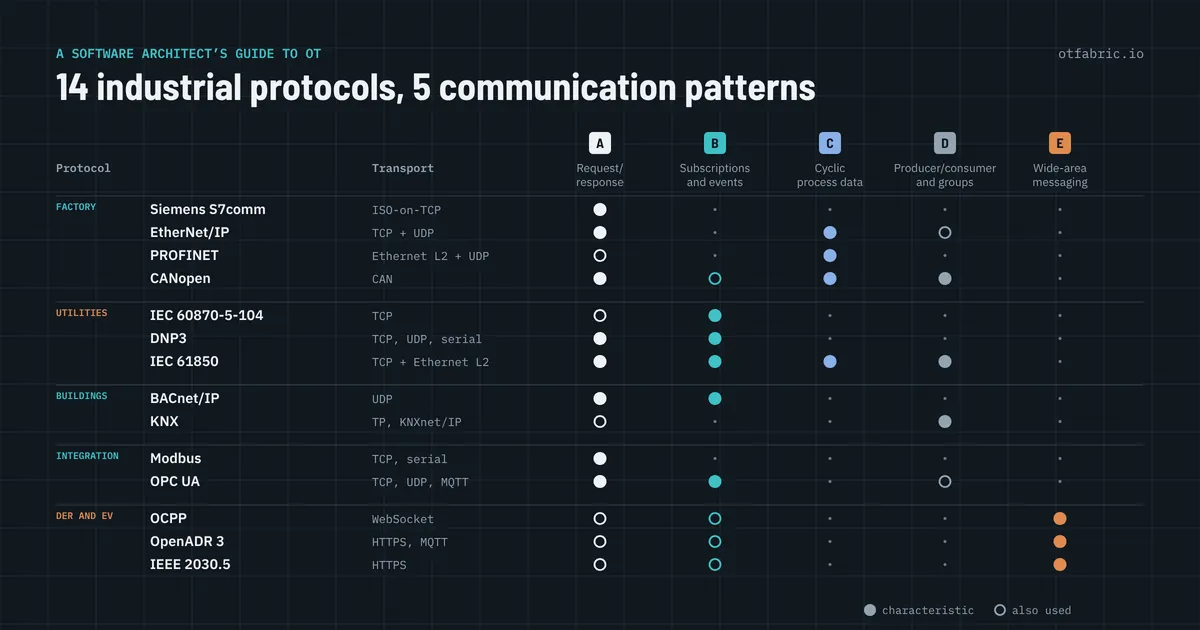
Industrial communication is not one architecture with fourteen wire formats. Modbus, OPC UA, BACnet, IEC 104, IEC 61850, S7, DNP3, EtherNet/IP, PROFINET, CANopen, KNX, OCPP, OpenADR and IEEE 2030.5 make different promises about who speaks, when data moves, what an acknowledgement means and what survives a failure. This guide maps them onto five patterns, and those patterns onto software architecture.
In software engineering, reading a value usually sounds straightforward: send a request and wait for a response.
Industrial automation has a few surprises.
Reading a Modbus meter may require polling it every second. An OPC UA server can report changes through subscriptions. A DNP3 outstation can retain time-stamped events for later retrieval. A CANopen device can broadcast process values to other nodes on a shared bus. A PROFINET device may exchange its I/O image every few milliseconds, without an application-level read request at all.
And that is before we attempt to write a value, operate a breaker, or manage a disconnected EV charger.
Across OT Fabric, we implement industrial protocols with very different histories and communication models. Looking at them side by side reveals something interesting: the hardest part is not always decoding a packet. It is understanding the communication contract.
This guide is the entry point of a series for software engineers and architects who are building software that talks to industrial equipment. It is not a certification guide and it does not teach any one specification. It explains why fourteen protocols behave so differently, and what that means for the software around them.
Why these protocols are different
Industrial protocols were not designed by one committee for one problem. Each grew out of an industry, with its own equipment, its own failure modes and its own idea of what “real time” means.
- Factory automation: Siemens S7comm, EtherNet/IP, PROFINET and CANopen. A controller scans its I/O every few milliseconds and a missed deadline stops a machine. These protocols separate configuration, which may be slow, from process data, which must arrive on time.
- Utilities and power automation: IEC 60870-5-104, DNP3 and IEC 61850. A control centre watches thousands of points over links that used to be slow, shared or expensive. The design answer was to report changes as time-stamped events, to buffer them in the device where the protocol and the device support it (DNP3 keeps events until the master confirms them; IEC 104 buffering is up to the station), and to control switchgear in deliberate, checked steps.
- Buildings: BACnet/IP and KNX. Many small devices from many vendors, installed by integrators, running for decades. BACnet models devices as objects with properties and change notifications; KNX lets a switch talk to a light through a group address without any central controller.
- Industrial integration: Modbus and OPC UA. Modbus is the lowest common denominator: registers, a request and an answer. OPC UA is the opposite end: a typed address space, sessions, subscriptions, events and security.
- Distributed energy and EV charging: OCPP, OpenADR and IEEE 2030.5. The equipment sits behind customer routers, on mobile networks and on the public internet. These protocols use HTTP, WebSockets and TLS, and they assume the device will be offline at times.
Five forces explain most of the differences: how tight the timing is, how long equipment stays in the field (twenty or thirty years is normal), what the network could carry when the protocol was designed, whether one central system is in charge, and whether the history of what happened matters as much as the current value. A protection engineer needs the order and time of events; a building controller mostly needs the current temperature.
Five patterns, not fourteen wire formats
Five patterns cover the communication behaviour of all fourteen protocols. They are lenses, not boxes: most protocols use several of them, and the interesting questions are often where one protocol combines two.
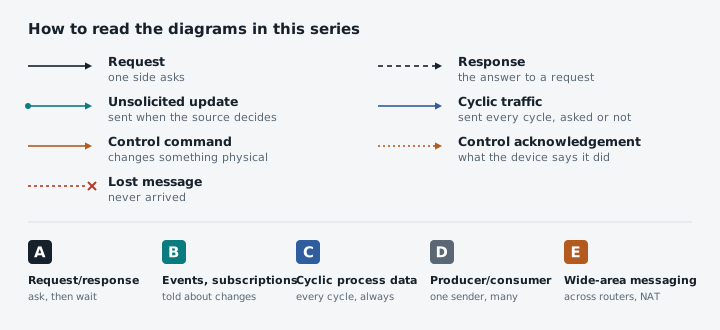
A. Explicit request/response. One participant asks for an operation and the other answers: a Modbus register read, an S7 read of a data block, BACnet ReadProperty, OPC UA Read, a CANopen SDO upload. The engineering concerns are outstanding requests, concurrency limits, timeouts, retries and how often to poll.
B. Subscriptions and event-oriented reporting. A participant receives updates without asking for each value again: BACnet change-of-value (COV), OPC UA monitored items, IEC 61850 reports, IEC 104 spontaneous transmission, DNP3 unsolicited responses. The concerns move to subscription lifetime, buffering, acknowledgements, ordering and what happens to a gap.
C. Cyclic process-data exchange. Devices exchange process data on a configured cycle, whether or not anything changed: PROFINET RT, EtherNet/IP implicit (Class 1) I/O, synchronous CANopen PDOs, IEC 61850 Sampled Values. The concerns are cycle time, jitter, deadlines, watchdogs and the moment data stops being fresh.
D. Producer/consumer and group communication. Data is produced once for whoever needs it, rather than returned to one requester: KNX group telegrams, CANopen PDOs, IEC 61850 GOOSE, OPC UA PubSub. The concerns are addressing, fan-out, multicast, filtering, sequence numbers and how a receiver knows its data is still valid.
E. Wide-area application messaging. Long-lived or HTTP-based relationships across networks nobody controls end to end: OCPP, OpenADR, IEEE 2030.5. The concerns are NAT and firewalls, who owns the connection, reconnects, credentials, scheduled operations and catching up after an offline period.
Four dimensions that are easy to confuse
Before comparing protocols, separate four questions that are often merged into one:
- Synchronous or asynchronous is used in two senses. In this series it describes whether the calling code waits for the result, which is a property of the API, not of the wire. The same words also describe communication behaviour, such as whether messages follow a shared clock; where that meaning is intended, the text says so.
- Request/response or one-way describes whether a message expects an answer.
- Polling or publishing describes who decides when data moves.
- TCP or UDP describes the transport, and says little about the application contract.
A TCP connection can carry asynchronous application messages in both directions, as OCPP does. An asynchronous notification can still require an acknowledgement, as a DNP3 unsolicited response does. A UDP protocol can implement confirmed transactions with retries, as BACnet/IP does. And publish/subscribe does not imply a broker: OPC UA PubSub over UDP multicast, KNX routing and GOOSE have none. Keeping these dimensions apart prevents most of the misleading comparisons you will find elsewhere.
The comparison matrix
The two tables compress each protocol to its characteristic behaviour. The exceptions, options and version differences are in the linked articles and in the protocol documentation.
Who talks to whom. Transport and roles:
| Protocol | Transport | Roles |
|---|---|---|
| Modbus | TCP 502; RTU and ASCII on serial | Client/server |
| OPC UA | TCP 4840 (also WebSocket, HTTPS); PubSub over UDP, Ethernet, MQTT, AMQP | Client/server, optional reverse connect; PubSub publisher/subscriber |
| BACnet/IP | UDP 47808; BBMDs across subnets | Client/server per service; any device can be both |
| IEC 104 | TCP 2404 | Controlling station / controlled station |
| IEC 61850 | MMS on TCP 102; GOOSE and Sampled Values on Ethernet | Client/server; publisher/subscriber |
| Siemens S7comm | ISO-on-TCP (TPKT, COTP), TCP 102 | Client/server; the PLC serves |
| DNP3 | TCP or UDP 20000; serial | Master/outstation |
| EtherNet/IP | TCP 44818 explicit; UDP 2222 implicit | Client/server; originator/target; producer/consumer |
| PROFINET | Ethernet frames for RT; DCE/RPC over UDP for setup and records | IO-controller, IO-device, IO-supervisor |
| CANopen | CAN | SDO client/server; PDO producer/consumer; NMT master |
| KNX | TP1 bus; KNXnet/IP tunnelling and routing, UDP 3671 | Group senders and receivers |
| OCPP | WebSocket, JSON, over TLS | Charger is the WebSocket client; both sides send calls |
| OpenADR 3 | HTTPS REST; webhook notifications, plus optional MQTT notifications since 3.1 | VTN server; VEN and business-logic clients |
| IEEE 2030.5 | HTTPS with client certificates, XML or EXI | Server; clients poll, optional subscriptions |
How data, control and recovery work:
| Protocol | Read path | Write path | Events and alarms | After a failure |
|---|---|---|---|---|
| Modbus | Explicit reads, polled | Write registers or coils; the reply echoes the address and the value or quantity | None | Poll again |
| OPC UA | Read; subscriptions with monitored items | Write; method calls | Events, Alarms and Conditions | Reactivate session, transfer or recreate subscriptions, Republish, ConditionRefresh |
| BACnet/IP | ReadProperty(Multiple); SubscribeCOV | WriteProperty, with a 16-level priority array | Event notifications to recipient lists; AcknowledgeAlarm | Renew COV subscriptions; GetEventInformation for active events |
| IEC 104 | General interrogation, then spontaneous data | Commands with select/execute; ACTCON, and ACTTERM where the station sends it | Spontaneous, time-tagged ASDUs; acknowledgements per connection; buffering depends on the station | STARTDT, general interrogation, clock synchronization |
| IEC 61850 | Reads; buffered and unbuffered reports; Sampled Values | Control models: direct or select-before-operate, normal or enhanced security | Reports, GOOSE state changes, logs | Resume buffered reports by EntryID if the buffer still holds it; general interrogation; next GOOSE repeat |
| Siemens S7comm | Explicit reads of DBs, inputs, outputs, markers | Explicit writes | Not used by typical third-party clients | Poll again |
| DNP3 | Integrity and event polls; unsolicited responses | Control relay output blocks and analog outputs, select-before-operate or direct | Class 1 to 3 events, buffered until confirmed, within the buffer size | Event poll, integrity poll, IIN flags |
| EtherNet/IP | Explicit reads; input data every RPI | Explicit writes; output data in every packet | No event history; change-of-state connections | Forward_Open again |
| PROFINET | Input data every cycle | Output data every cycle; record writes | Diagnosis and process alarms, acknowledged | Re-establish the application relationship |
| CANopen | SDO uploads; PDOs on SYNC or on change | SDO downloads; receive PDOs | Emergency messages; heartbeat | NMT commands, re-read by SDO |
| KNX | Group telegrams; group reads | Group writes, unanswered | Status on separate group addresses; no history | Read status objects |
| OCPP | Meter values, status and transaction messages from the charger | Calls from the CSMS, such as RequestStartTransaction and SetChargingProfile | Status and event notifications | BootNotification, status, queued transaction messages |
| OpenADR 3 | VEN polls or is notified | Events with intervals; VEN posts reports | Object notifications | Read the VTN again; state lives on the server |
| IEEE 2030.5 | GET at the server’s pollRate; notifications | DER controls with start time and duration; Responses | Notifications to subscribers | Poll again; fetched schedules keep running |
CAN bus is not in the tables because it is a transport rather than an application protocol, but its arbitration and broadcast nature shape everything CANopen does. MQTT appears in this series as a point of comparison for brokered publish/subscribe, and Sparkplug B as an example of state on top of it, but neither is analysed as a protocol here.
Who initiates communication?
The participant that opens a connection is not necessarily the one that asks the questions afterwards. Three protocols make the point.
In Modbus/TCP the two coincide. The client opens the TCP connection and sends every request; the server only answers. A Modbus server never speaks first.
In OCPP they split. The charging station opens a WebSocket to its management system, the CSMS, because the charger is the one behind a customer router or a mobile network that would never accept an incoming connection. Once the WebSocket is up, both sides send requests: the charger sends BootNotification and TransactionEvent, the CSMS sends RequestStartTransaction and SetChargingProfile. The transport client is an application server for half the conversation.
In KNX the question barely applies. A wall switch sends a GroupValue_Write to a group address; every device that has a communication object linked to that address acts on it. Nobody opened a session, nobody is the server, and the sender does not know who listened.
OPC UA adds a further twist with reverse connect, where the server opens the TCP connection to the client so that a device inside a plant network can reach a client outside it without an inbound firewall rule; after that, the client still opens the session and sends the requests.
So a software design needs at least three separate concepts: who owns the network connection, which application role each side plays, and in which direction each message type flows. Who is the client? works through roles, bidirectional RPC and publish/subscribe in detail.
How does data move?
Polling, subscriptions, spontaneous reporting, event queues and cyclic exchange answer the same question in different ways: who decides when the application gets a value?
- With polling, the application decides. Modbus and S7 clients read on a schedule. The cost is paid every cycle whether or not the value changed, and anything that happens between two reads is invisible.
- With a subscription, the application decides what it wants and the server decides when to send it. A BACnet COV subscription has a finite lifetime that must be renewed or, where supported, an indefinite one that is still best renewed periodically, because a device restart can erase it. An OPC UA subscription samples values at one interval and publishes notifications at another.
- With spontaneous reporting and event queues, the device decides. An IEC 104 station sends a spontaneous ASDU when a point changes; a DNP3 outstation stores events in classes and sends them unsolicited or when polled, and keeps each one until the master confirms it, as long as its buffer does not overflow.
- With cyclic exchange, the configuration decides. A PROFINET IO-device sends its inputs every cycle once the relationship exists; nobody asks for them.
A subscription is not necessarily an unsolicited packet in the literal sense. OPC UA notifications travel as responses to Publish requests that the client keeps queued at the server; the server decides when to answer, but the client still sent the request first. The behaviour is event-driven while the wire is request/response, which is exactly why the four dimensions above need to stay separate.
Reading industrial data compares the read paths of nine protocols and shows when each one is the right fit. Time, freshness and ordering follows the value after it arrives: how old it is, and whether it arrived in the order it happened.
How does control work?
A write in a typical web API returns 200 and the database row has changed. Industrial writes are not that simple, because the thing being written is often a physical process.
- Writing a Modbus holding register returns an echo: the address and value for a single register, the starting address and quantity for several. It means the device accepted the value. Whether an inverter has actually ramped down to the new power limit is a separate question that only a later reading can answer.
- Select-before-operate, in DNP3, IEC 104 and IEC 61850, splits a control into a selection, which arms the output and checks the command, and an operation, which must repeat the same parameters within a timeout. IEC 61850 with enhanced security then sends a termination message when the operation has finished, and an IEC 104 station may send one, depending on the command and the station.
- Cyclic outputs, in PROFINET and EtherNet/IP, have no write request at all. The controller changes a byte in the output image and the next cycle carries it. There is no per-value acknowledgement; the inputs coming back are the feedback. If the connection fails, what the outputs do is a device configuration, which can include holding the last value.
- Remote EV charging commands are accepted long before they take effect. An OCPP RequestStartTransaction answered with Accepted means the station accepted the request, not that energy flows. In OCPP 2.0.1 the point at which a transaction starts is configurable, for example plugging in, authorization or energy transfer, so the TransactionEvent that reports it may come later or may already have been sent.
The common thread is that the response to a command tells you less than an API usually does. Writing to industrial equipment separates delivered, accepted, executed and verified, and looks at what a timeout really means.
What happens when the network fails?
Take a deliberately simple situation: a gateway is offline for two minutes. While it is away, an alarm is raised and cleared again.
- A Modbus poller comes back and reads the current value. The alarm never happened as far as it knows.
- A BACnet client resubscribes and reads the current state. The transient is gone unless the device kept it in an event log that the client then reads.
- A DNP3 master runs an event poll and receives both events with their time stamps, provided the points are assigned to an event class and the buffer did not overflow. The outstation kept them until they were confirmed, and sets an overflow flag if it could not.
- An IEC 61850 client with a buffered report resumes from the last entry it received, if it can reserve the report control block again and the server still holds the entries.
- A GOOSE subscriber sees only the current state; a jump in the state number suggests that it missed something, unless the publisher restarted.
- A KNX gateway has lost the telegrams for good, because KNX has no standard replay of group telegrams, and must read every status object that allows it.
The same two minutes produce four different answers: a fresh read, recovered history, a known gap and silent loss. None of them is wrong; they are different contracts. Industrial events and alarms compares eight protocols on delivery, persistence and recovery. Reconnecting is not recovering covers the session state that has to be rebuilt, and Time, freshness and ordering covers what the recovered data can and cannot tell you.
What this means for software architecture
The usual first design for a multi-protocol system is a universal device client with Read, Write and Subscribe. It is attractive because it fits on a slide, and it fails in predictable ways:
Readon a DNP3 point quietly turns an event-driven protocol into a polled one and throws away its time stamps.Subscribeon Modbus becomes a hidden poll loop whose rate nobody chose.Writereturns success for a PROFINET output that is only carried in the next cycle, and for a breaker command that has been accepted but not executed.- Cyclic I/O placed on a general-purpose scheduler shares its timing with everything else in the process.
A more honest structure has separate execution paths: a polling scheduler for request/response sources, an event pipeline with ordering, deduplication and backpressure, an isolated cyclic I/O loop with watchdogs, and a command service that tracks each command through its stages. Under each protocol sits its own connection state machine, often implemented as one actor per session, so that a reconnect means the protocol-specific recovery and not just a new socket.
A shared abstraction is still useful, as long as the differences stay visible: a capability that a protocol does not have should be absent, not emulated without saying so. Designing a multi-protocol gateway turns these lessons into interfaces and components, and Why industrial real-time communication is not just faster TCP explains why the cyclic path needs its own treatment.
Conclusion
OT interoperability is not just the ability to exchange bytes with different equipment.
It is the ability to understand and honor different communication contracts: who owns the conversation, when information is exchanged, what constitutes an acknowledgement, and which state survives failure.
Those contracts should influence the software architecture rather than being hidden behind an overly generic API.
The series that follows takes one question at a time. Each article compares several protocols, uses three running examples (reading an inverter, operating a breaker, and managing an EV charger behind a customer router) and ends with a practical lesson for the software you are building.
Different wires. Different conversations. Different guarantees. One architectural perspective.