

Writing to industrial equipment: why an acknowledgement is not the same as execution
What does a successful command actually guarantee? A Modbus write, a DNP3 select-before-operate, an IEC 104 command, an IEC 61850 control, a PROFINET output, an OCPP remote start and an IEEE 2030.5 DER control each confirm something different. Separating delivered, accepted, executed and verified makes retries safe and results honest.
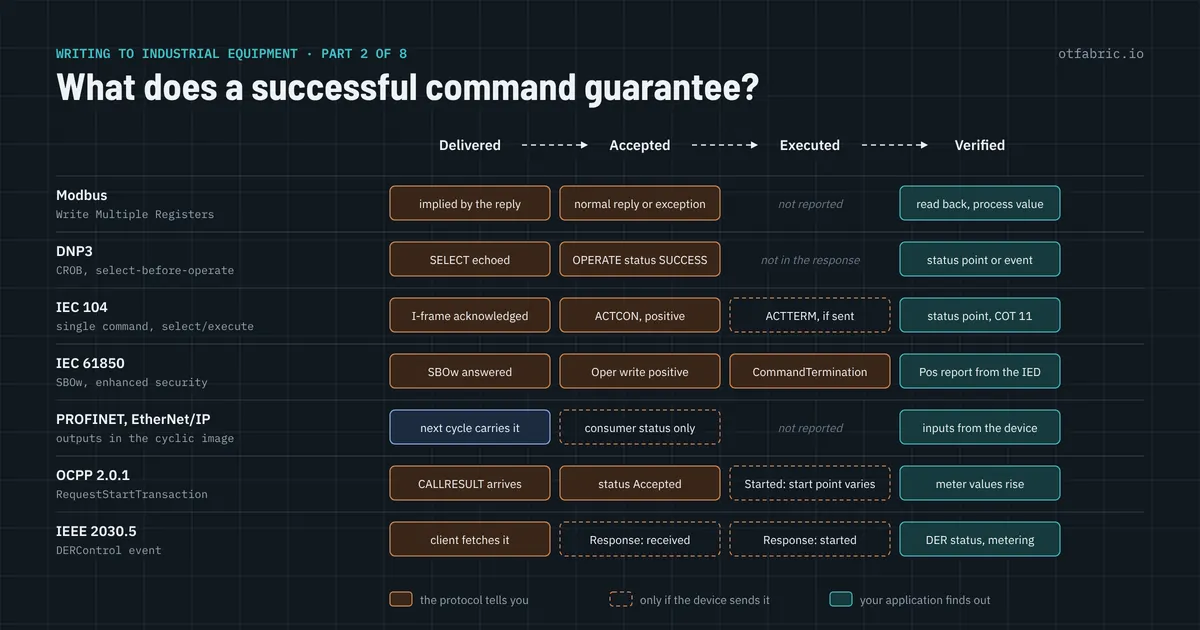
In most software, a successful write is the end of the story. The API returned 200, the row changed, the cache was invalidated. Industrial commands are different because the thing being changed is often physical: a power limit, a breaker, a valve, a charging session. A command can be received and rejected, accepted and not yet executed, executed and not yet visible, or visible and then undone by something else.
So the question for this article is: what does a successful command actually guarantee?
It is part of the series that starts with 14 industrial protocols, 5 communication patterns.
Four stages of a command
A gateway can track a command through four stages. They are an interpretation for application design, not stages that every protocol defines or makes observable. Protocols report some of them and stay silent about others.
- Delivered: the request reached the device. The transport or protocol confirms that bytes arrived and were understood.
- Accepted: the device checked the request and agreed to act on it. It may still refuse later, or be overridden.
- Executed: the device has carried out the action, as far as the device knows.
- Verified: an independent observation of the process confirms the intended effect: the measured power fell, the breaker position changed, energy is flowing.
The cover of this article shows which stages each protocol reports. The pattern is consistent: protocols are good at the first two, some report the third, and none of them can do the fourth for you.
Simple write operations
A Modbus Write Single Register (function 06) is answered with an echo of the register address and value; Write Multiple Registers (function 16) is answered with the starting address and the number of registers written. Either can instead return an exception code: illegal address, illegal value, device busy, server failure. A normal response means the device accepted the value into its register. It does not say what the device did with it.
Take the first running example, setting an inverter’s active power limit to 50 percent. The write returns immediately. The inverter then ramps its output at a configured rate, perhaps over several seconds, and may not reach the limit at all if a grid code function, a local setting or a higher-priority control takes precedence. Some devices only apply a limit after a separate enable register is written, or revert to a default when a timeout register expires. Reading the register back proves only that the value was stored. The proof of execution is the measured power.
BACnet adds a twist that every building integrator learns early. WriteProperty to a commandable object, such as a binary output, carries a priority from 1 to 16. The object keeps a priority array with one slot per priority, and the present value follows the highest-priority slot that is not NULL. A successful write at priority 8 may not change the present value at all, because a higher-priority slot, such as a life-safety command at priority 1 or a manual operator command at a priority above 8, already holds the output. The slot belongs to the priority, not to a client: a later write at priority 8 from anyone replaces your value. Releasing your command means writing NULL at priority 8, after which the next active priority, or Relinquish_Default when no slot is active, decides the value. Writing the old value is not the same as releasing. Priority arrays apply to commandable properties; other writable properties simply take the written value.
Request acknowledgement versus operational confirmation
Utility protocols were designed for controls where a wrong action costs money or safety, and they split acknowledgement into steps.
In IEC 60870-5-104, a single command (C_SC_NA_1) travels from the controlling station to the controlled station. The station answers with an activation confirmation (ACTCON), positive or negative: the command was accepted or refused. When the operation completes, a station may send an activation termination (ACTTERM). Whether it does, and what exactly “complete” means, depends on the command type and on the station: many stations send ACTTERM for commands that run for some time, such as regulating step commands, and some never send it. The new state of the controlled point then arrives as monitoring information, typically with cause of transmission return information caused by a remote command. Three messages, three different facts.
In IEC 61850, a control object declares its control model: direct with normal security, select-before-operate with normal security, direct with enhanced security, or select-before-operate with enhanced security. With enhanced security the server checks the operation and sends a CommandTermination when it has finished, positive or negative with an additional cause. With normal security, the positive response to the Oper write means accepted, and the result is only visible in the status that follows.
In DNP3, a control relay output block or analog output is sent with Select and Operate, Direct Operate, or Direct Operate No Ack. The response echoes the request with a status code per object: SUCCESS, or a reason such as TIMEOUT, NO_SELECT or NOT_SUPPORTED. SUCCESS is the result of the outstation’s control processing: it accepted the operation and, depending on its implementation, may already have pulsed or latched the output. It is not a report that the physical equipment completed its movement. DNP3 has no separate execution message; the outcome appears as a change of the related binary or analog input, often reported as an event.
Select-before-operate and other multi-step controls
Select-before-operate exists because an output is too important to drive from a single message. The control is split into two requests with the same parameters:
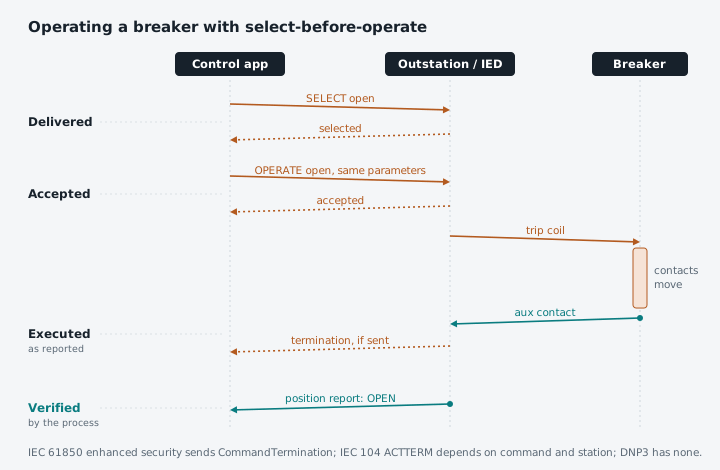
- Select arms the output for this control. The device checks that the point exists, that the command is allowed in the current state and mode (local or remote, interlocks, other selections) and starts a select timeout. How strictly a selection excludes other masters, local operators or automatic functions depends on the device; it is a control procedure, not a lock on the equipment.
- Operate must repeat the same parameters before the timeout expires. In DNP3 it must also follow the select with the next sequence number. Anything else is refused.
This is the second running example: operating a breaker. The breaker’s mechanism takes tens of milliseconds to move; its auxiliary contacts then change the position indication that the IED or RTU reports. A control application that considers the command finished at the Operate response has completed two of four stages.
Select-before-operate guards against the wrong output being driven by a corrupted or misdirected message. It is not a transaction in the database sense: it does not roll back, and it says nothing about the physical result.
Setting an output through cyclic process data
In PROFINET and EtherNet/IP Class 1 connections there is no write request. The controller changes bits in its output image and the next cycle carries them to the device, and every cycle after that carries them again.
That has interesting consequences:
- There is no per-value acknowledgement. PROFINET carries a consumer status per item of data, which says that the receiving side consumed valid data in general, not that it acted on a particular change.
- A value that is set and reset again within one cycle never leaves the controller.
- If the connection is lost, the watchdog marks the I/O connection as failed. What the outputs do then is a property of the device and its configuration, not of the protocol: depending on the module, they go to configured fault values, switch off, or hold their last state, on some equipment indefinitely. Never infer a safe physical state from the loss of the cyclic connection; configure the fault behaviour you need and test it.
- While the connection is healthy, the output is a continuous assertion, not a one-off event.
The verification path is the same as for any command: the inputs that come back. The difference is that cyclic I/O makes the loop explicit. A PLC program writes an output and reads a feedback input in the next scan; a supervisory application should do the same at its own pace.
Remote commands with delayed physical effects
The third running example: a charging station behind a customer router is managed over OCPP. The CSMS sends RequestStartTransaction (OCPP 2.0.1, or RemoteStartTransaction in OCPP 1.6). The charger answers with a status of Accepted or Rejected.
Accepted means the charging station accepted the remote-start request; it does not prove that energy transfer began. When the transaction starts is configurable in OCPP 2.0.1: the station’s transaction start point can be, for example, the cable being plugged in, the authorization, or the power path being closed. Depending on that setting and on the station’s state, a TransactionEvent of type Started may already have been sent before the request arrived, or may follow later (in 1.6, a StartTransaction request follows once the station starts charging). Energy transfer needs its own confirmation from the charging state and the meter values, which arrive on the station’s schedule. A driver who never plugs in leaves an accepted command that never executes, and the CSMS learns that only from the absence of charging within a timeout it chose.
Commands that are scheduled for a future time
IEEE 2030.5 and OpenADR add time. A DERControl in IEEE 2030.5 is an event with a start time and a duration. The device’s client fetches it from the server, typically by polling at the server’s pollRate, and acts on it when it starts. If the server asks for responses, the client posts Response resources as the event moves through its life: received, started, completed, or superseded, cancelled, opted out. In OpenADR 3, a VTN publishes events with intervals and payloads such as prices or import capacity limits, and the VEN decides how its resources respond.
So “accepted” can be hours away from “executed”, and between the two the device may be offline. The command must be correct at execution time, not just at delivery time: superseded events, overlapping schedules and clock errors all matter. The posted responses are statements from the device, not measurements; verification still comes from metering and status.
Timeout ambiguity
The most dangerous moment in industrial control is a timeout.
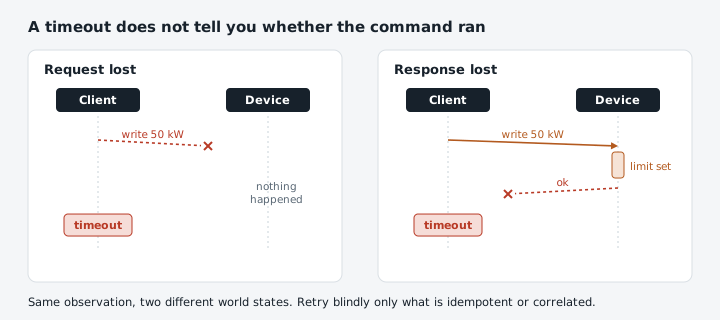
When a command times out, the application does not know whether the request was lost, the device refused, the device executed and the response was lost, or the device is still executing. Retrying blindly can turn one operation into two: a breaker toggled twice, a counter incremented twice, a second charging session.
Idempotency, correlation and safe retries
Three techniques make retries safe:
- Idempotent commands: “set the power limit to 50 percent” can be repeated safely; “reduce the limit by 10 percent” cannot. Prefer absolute set points to relative ones, and states (“open”) to toggles.
- Correlation: give each command an identifier and check the outcome before retrying. OCPP calls carry a unique message id; DNP3 and IEC 104 controls can be matched to the status changes they cause; IEEE 2030.5 events have an mRID that responses refer to.
- Read before retry: after a timeout, read the state the command was meant to change. If it is already in the requested state, there is nothing to retry. That proves the equipment is in the requested state; it does not prove that your command caused it. The point may already have had that value, or another controller or an operator may have changed it, which matters for redundant controllers, command races and safety-related operations.
Some libraries make this policy explicit. go-dnp3, for example, retries only requests that are safe to repeat, such as reads and time synchronization, and never repeats controls, freezes, restarts or writes automatically; deciding whether to send a control again is left to the application.
Verification through independent process feedback
Verification is always the application’s job, and it should use information that does not come from the command path itself:
- the inverter’s measured active power, not the limit register;
- the breaker’s position indication, ideally a double point with both auxiliary contacts, not the control response;
- the charger’s meter values and connector status, not the RequestStartTransaction answer.
Verification needs a deadline and a tolerance: the power should be below the limit, within a margin, within a ramp time. Without them, “verified” becomes “eventually, maybe”.
Practical lesson
An application-level command result should preserve the difference between communication success and process success. A useful command record holds the stages separately, each with a time: delivered, accepted, executed, verified, or failed at a named stage with a reason. Retries should be driven by that record, not by a generic retry wrapper around a write call.
Reconnecting is not recovering covers what happens to commands in flight when a session is lost, and Designing a multi-protocol gateway turns the command stages into a command service.