

openadrctl: OpenADR 3 from the command line, in every role
openadrctl acts as a VEN or as Business Logic against any OpenADR 3 VTN, publishes prices and limits, listens for notifications by webhook, MQTT or WebSocket, and serves a test VTN from a seed file. With go-openadr v0.5.0 it also talks to VTNs of OpenADR 3.0.1.
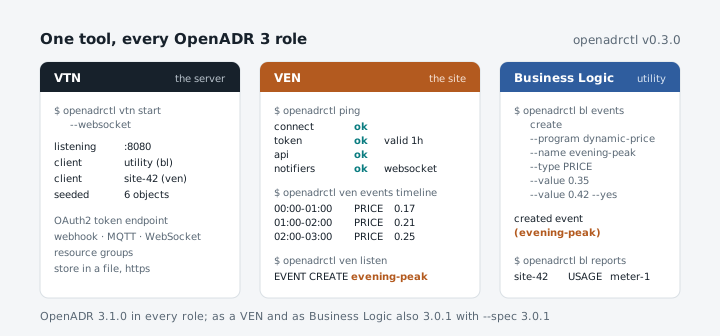
OpenADR was the one protocol on OT Fabric without a command-line tool. Its library, go-openadr, shipped three example programs instead, which is fine for a developer with a checkout and not much use at a site with a laptop. Today that gap closes with openadrctl.
OpenADR 3 is a REST API, so curl can reach every endpoint. What it cannot do by itself is fetch and renew an OAuth2 token, page through a search, check an object against the schema before it goes out, work out when each interval of an event is in force, or hold a webhook, MQTT or WebSocket subscription open. openadrctl does all of that, in every role.
Every role, from one binary
- As a VEN, the site’s side: read the programs and events meant for the site, see an event’s intervals laid out in time, send reports, and manage the VEN object and its resources.
- As Business Logic, the utility’s side: create programs and events such as price signals and load limits, from flags or a CSV file, read what VENs report, and manage VENs, resources and resource groups.
- As a VTN:
vtn startserves a test VTN from a YAML seed, with its own OAuth2 token endpoint, webhooks, MQTT, WebSockets and a store in a file.
openadrctl vtn start --websocket                       # terminal 1: a VTN with an example seed
export OPENADRCTL_URL=http://127.0.0.1:8080            # terminal 2: the siteexport OPENADRCTL_CLIENT_ID=site-42 OPENADRCTL_CLIENT_SECRET=site-42-secretopenadrctl ping                                        # every step, timedopenadrctl ven events timeline price-2030-01-01        # interval by intervalopenadrctl ven listen --via websocket --object EVENT   # wait for new events
From a third terminal, the utility publishes an evening peak price, and the VEN prints it as it arrives:
$ OPENADRCTL_CLIENT_ID=utility OPENADRCTL_CLIENT_SECRET=utility-secret \ openadrctl bl events create --url http://127.0.0.1:8080 --program dynamic-price \ --name evening-peak --type PRICE --start 2030-01-01T17:00:00Z --interval PT1H \ --value 0.35 --value 0.42 --yescreated event 919fe864521e897f30c7b9a2ffed4491 (evening-peak)Built for the field and for CI
ping checks connect, TLS, token, API and notifiers one by one, and says which step failed and what to check. Secrets come from the environment or a file, never from a flag. Every command with a result has --format json, the streams write JSON Lines, and the exit codes are stable, so a VTN regression test is a shell script. Events and deletes need --yes, and --dry-run shows an object without sending it, because an event reaches real sites.
OpenADR 3.0.1 too
Not every VTN has moved to 3.1. go-openadr v0.5.0, released today as well, teaches its clients OpenADR 3.0.1: typed targets, resources under their VEN, reports that name their program, and the token from /auth/token. openadrctl exposes it as --spec 3.0.1. What 3.0.1 does not have, such as MQTT topics and resource groups, is refused before anything is sent.
Tested against independent stacks
openadrctl runs against the reference VTNs of openadr-interop v0.5.0, which now adds OpenLEADR v0.1.4 as a VTN of OpenADR 3.0.1:
| Run | Result |
|---|---|
Both roles against OpenLEADR v0.2.7 (3.1.0): programs, events, reports, a refused token, events watch, WebSocket and MQTT |
25 checks passed |
--spec 3.0.1 against OpenLEADR v0.1.4: typed targets, resources through their VEN, reports, validate |
37 checks passed |
MQTT logins by OAuth2 token, checked by EMQX 6.3.1 against vtn start |
5 checks passed |
Get it
Prebuilt binaries for Linux, macOS and Windows are on the releases page, and the openadrctl docs cover installing and every command. The guide walks through each scenario with real output. openadrctl is MIT-licensed. Security issues go to security@otfabric.io.